Table Of Content
While it would be nice to design a 3-waypassive loudspeaker with an 80Hz subwoofer to midrange-woofer crossoverfrequency, the crossover parts at this frequency are pretty expensive. This is one application where activecrossovers have a huge advantage over passive crossovers. Since the Peerless XXLS woofer response getsa little funky above 700Hz, we will shoot for a crossover frequency a minimumof an octave below to reduce the amount of response shaping required.
The art of speaker design, explained by a master - CNET
The art of speaker design, explained by a master.
Posted: Sat, 24 Mar 2018 07:00:00 GMT [source]
Understanding Audio Frequency Range in Audio Design

It ispossible to get pretty deep bass out of a smaller cabinet but the efficiencyand total acoustic power are typically much lower. For this sample project, we will set areasonable design goal of +/- 3dB from 35-20kHz with the ability to generate aminimum of 100dB SPL at 1 meter with an impedance minimum of 4 ohms. Mounting a speaker driver or its enclosure significantly influences sound quality, a factor governed by speakers’ complex mechanics and soundwaves’ behavior. Common errors in this process range from choosing inappropriate materials to over-tightening screws, all of which we’ll delve into. Understanding the significance of a speaker’s surrounding environment is paramount. Finally, think about any additional features you might need in a speaker box.
Why Is Box Design Important for Subwoofers?
If thecrossover parts are expensive, you can attempt to reduce component values andsubsequently plot their effect on the final response. Using cheapelectrolytic capacitors this crossover costs close to $150 for componentsalone. During the designprocess, it is important to pay close attention to system impedance graphs. It is no fun perfecting frequency when yourdesign has a minimum impedance of 1.5 Ohms.
Seven sculptural speakers that go to 11 Wallpaper - Wallpaper*
Seven sculptural speakers that go to 11 Wallpaper.
Posted: Sat, 03 Jun 2023 07:00:00 GMT [source]
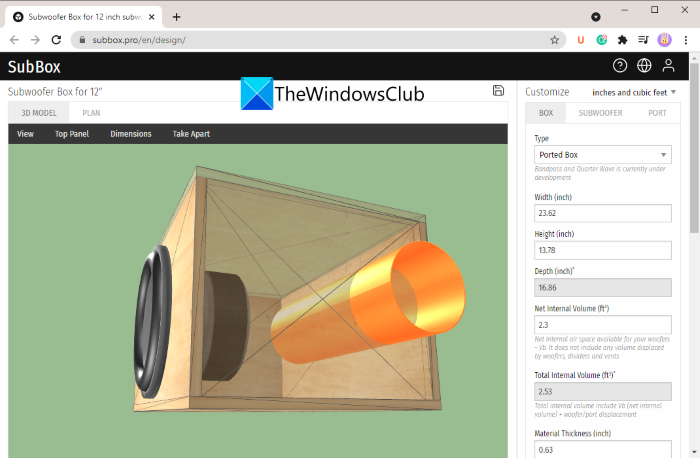
Subwoofer Box American Bass Home System Xr12
This means that each loudspeaker driver has its own amplifier, and in the DIY world this is not especially difficult or expensive to do. Passive crossovers (using capacitors, inductors and resistors) take the full-range signal from the power amp, and divide the frequency range so that each driver gets only those frequencies it can handle. Of course, the points made above are suggestions, and are not intended as 'rules'. Many very successful commercial systems use a larger mid-bass driver, and can still perform very well.
Online Tone Generator for Loudspeaker Test
The best response was obtained with the rear of the magnets in-line, and the impulse response is shown below. Such systems interact with the walls, floor and ceiling of the listening space very differently from a 'conventional' enclosure. Positioning will usually be fairly critical, but there are many who are firmly convinced that this is a better way to build a speaker.
Each sub-section plays a crucial role in creating a superior audio experience. Explore the science behind these elements and how they work together to deliver optimal sound quality. In addition to fourth-order bandpass speaker enclosures, there are also sixth-order and eighth-order speaker enclosures. In general, these speaker box types are difficult to design and a good level of knowledge and design criteria are required to ensure you get the sound you want from your speaker. As sound waves travel through this sealed chamber, they are loaded onto the speaker cone and a low-frequency resonance is created.
Considering the majority of music content isabove 40Hz, the group delay for the vented enclosure will suffice for thisproject. A speaker bandpass enclosure, also called a “fourth-order bandpass” enclosure, is designed to maximise the transfer of energy from a speaker driver to the air. This type of enclosure typically consists of two chambers that are tuned at specific frequencies. Unlike an infinite baffle, the internal volume of the sealed box is less than the speaker Vas. This has the effect that the air inside the box acts like a spring which will dampen the speaker.
Building a DIY Speaker: Driver Selection
Even a small variation of impedance across the crossover region can have serious effects on the accuracy of the network. If you find one that suits your needs and sounds good, then you get the benefit of well controlled dispersion, very little lobing, and a true point-source - at least for the mids and highs. Large coaxial drivers (e.g. 300mm (12") or greater) become a compromise, and the horn tweeter isn't to everyone's liking in any size. With many of the smaller drivers, the 'horn' is more of a waveguide than a true horn, potentially minimising the oft-complained of 'horn sound'. Choosing drivers that have a tweeter suspended in front of the main driver might work for you, but I know of no commercial loudspeakers that use that arrangement.
Speaker Box Design
If you obtain the cube root of 15 (³√15) you get 2.466 (2.47 is quite close enough) with the answer in decimetres - something I generally avoid like the plague. Obtaining the cube root is a bit of an issue in itself, since most references omit the simple way to calculate it. You can get an idea of the gyrations that most 'maths' sites put you through from Cube Root Calculator at CalculatorSoup®. As noted earlier, braces should be asymmetrical, and not simply pieces of timber placed neatly around the inside of the cabinet.
The combined systemresponse after optimization for this design is shown below. When designing a speaker box, these three features are traded against one another. When it comes to picking the right type of speaker enclosure for your needs, there are a few key considerations you should keep in mind.
Foam surrounds were once common for woofers, but eventually the foam gives up and the surround has to be replaced or the driver scrapped. Some speaker enclosures have tapered, angled tops and upper sides [ 8 ], to keep the baffle area around the tweeter as small as possible. In a few cases, the baffle is trapezoidal, with the tapered sections extending from the top to the bottom of the enclosure (or a significant part thereof). These are usually difficult to build, but if done properly can give very good results. This is taking the idea of 'rounding' the edges/ corners to extremes, but it can produce a good result if done properly. Others (especially car speakers) claim to be 'concentric', but mount a small tweeter in front of the main driver, either on a sub-frame or an extension of the woofer's centre pole.


No comments:
Post a Comment